

Let me tell you about everything I did yesterday. I woke up at 5:45 and read thirty-two chapters in my Bible. After that, I did my regular thirty-mile bike ride, then gathered eggs from the henhouse and butchered a pig so I could fix myself bacon and eggs for breakfast. After breakfast I went to the Department of Motor Vehicles without an appointment to renew my driver’s license. Then I went home and mowed the lawn using hand-clippers, then split and stacked ten cords of firewood by hand (no hydraulic log splitter for me!). Next, I painted the house, inside and outside, using watercolor paint brushes. In the evening, I watched The Lord of the Rings extended edition from start to finish (including all the extra DVDs) then read the entire trilogy to remind myself about how it really happened. I ended the day by organizing 20,000 digital photos on my computer, and was in bed by 10:15. Just another average day in my life.
What? You don’t believe me?
| Series: Truths Worth Repeating Truth 2 – A persistent problem with young-Earth geology is Too Many Events, Too Little Time. Summary: Young-Earth geology is plagued by a persistent problem of trying to squeeze too many time-consuming geological events into a very short time frame. |
Okay, I confess that my intro paragraph in this article about truth wasn’t exactly true. Or even slightly true. The problem is obvious: There is no way one could pack all those things into a single day. Many of the individual tasks I listed could not have been accomplished in one day even aside from all the other things. One could say that there were Too Many Events in Too Little Time.
Young-Earth creationist geology is characterized by the same problem. Whether one is looking at igneous, sedimentary, or metamorphic rocks; the fossil record, ancient ecosystems, geologic structures, plate tectonics, mineral deposits, glaciers, or landscapes, Earth’s geologic record tells a history of many successive events which would have taken time to unfold; more time than is allowed for in young-Earth creationist (YEC) timelines.
Before I go further, I want to emphasize that the problem is not a problem with the Bible itself, which I believe to be the inspired, infallible, and authoritative word of God. Instead, the problem is with young-Earth creationist geological speculations that are not part of Scripture itself.
Review of YEC Geology
Young-Earth flood geology takes most of the geological events of the Paleozoic, Mesozoic, and Cenozoic Periods of the standard geologic time scale and squeezes them down to a one-year period—the year of Noah’s flood. YEC geologists disagree among themselves about some of the details, such as where to put the flood/post-flood boundary, but almost all of them consider everything from the Cambrian through the Cretaceous periods to be flood rocks, and many of them put most of the Cenozoic (Paleocene through Pliocene epochs) into the flood as well. What this means is that they take what conventional geologists believe happened in about 480-540 million years (Cambrian through Pliocene) and reduce it down to one year, a compression of about 500,000,000 to one. They generally agree that the Pleistocene ice age occurred after Noah’s flood, sometime between Noah and Abraham (or so). This also involves time compression, taking 2.5 million years of glaciation and forcing it into as little as 300 years.
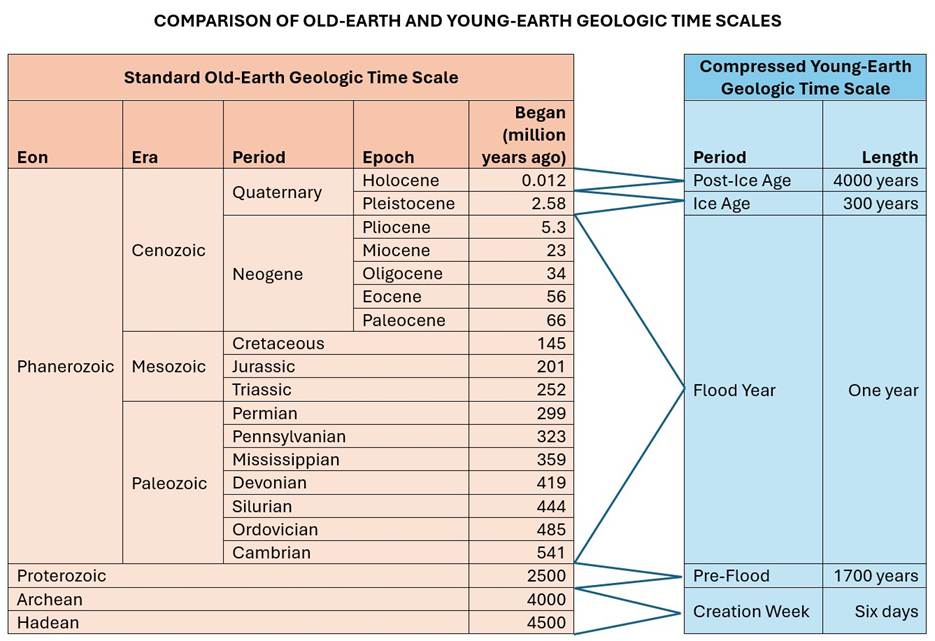
In terms of the relative order of events, young-Earth and old-Earth geological stories contain the same actions. If old-Earth geology has continents and islands colliding in the early to mid-Paleozoic Era to form the structures of the Appalachian Mountains and associated sedimentary, igneous, and metamorphic rocks, then most young-Earth geologists tell the same story, ending with the supercontinent of Pangea. If old-Earth geology has Pangea breaking apart in the Mesozoic Era, causing the Atlantic Ocean to form between the Americas and Europe and Africa, then YEC geology has the same order of events, with all the associated tectonic structures and rocks. The primary difference between the two is the timeline. Did all of this happen through ordinary geological processes over tens and hundreds of millions of years, or by catastrophic processes in just one year?
To accomplish all this in a short time span, YECs propose things like catastrophic plate tectonics, accelerated nuclear decay, catastrophic volcanism, catastrophic plutonism, catastrophic uplift of mountains, catastrophic erosion of those mountains, catastrophic deposition of sediments, catastrophic metamorphism, catastrophic storms to quickly form glaciers, and so forth. By catastrophic, they mean up to 500 million times faster than what old-Earth geologists accept.
It is important to emphasize again that YEC geology is not taught in the Bible. For now, I will just point out that the Bible does not require a young Earth and does not teach that most of Earth’s geology is the product of Noah’s flood. One may be a faithful reader and interpreter of the Bible and reject the entirety of YEC geology.
I know my YEC brothers and sisters in Christ disagree with much of what I have written so far, and I’m okay with that. I have my biblical reasons for what I believe, and they have theirs. We agree about more things, and more important things, than what we disagree about, and ought to be able to discuss our differences charitably and have fellowship with one another. Sometimes this happens, and sometimes it does not.
So how bad is the YEC Too Many Events, Too Little Time problem? I’ll illustrate this with the Castile Formation in Texas
Example: Evaporite Rocks of the Castile Formation
Evaporite rocks are chemical sedimentary rocks interpreted to have been formed by precipitation of various minerals by evaporation of seawater. If you heat a pot of seawater (or salt water on your stove), water will evaporate even if not brought to a boil, and the dissolved salt will begin to crystallize and sink to the bottom even before the water is all gone. The most common dissolved ions in seawater are sodium and chloride ions, which precipitate to form ordinary table salt, but seawater also contains potassium, calcium, sulfate, carbonate, and other ions. Evaporation of seawater (or saline lake water) leads to precipitation of various minerals such as halite (rock salt), gypsum (used in drywall), anhydrite (dehydrated gypsum), calcite (limestone), and others.
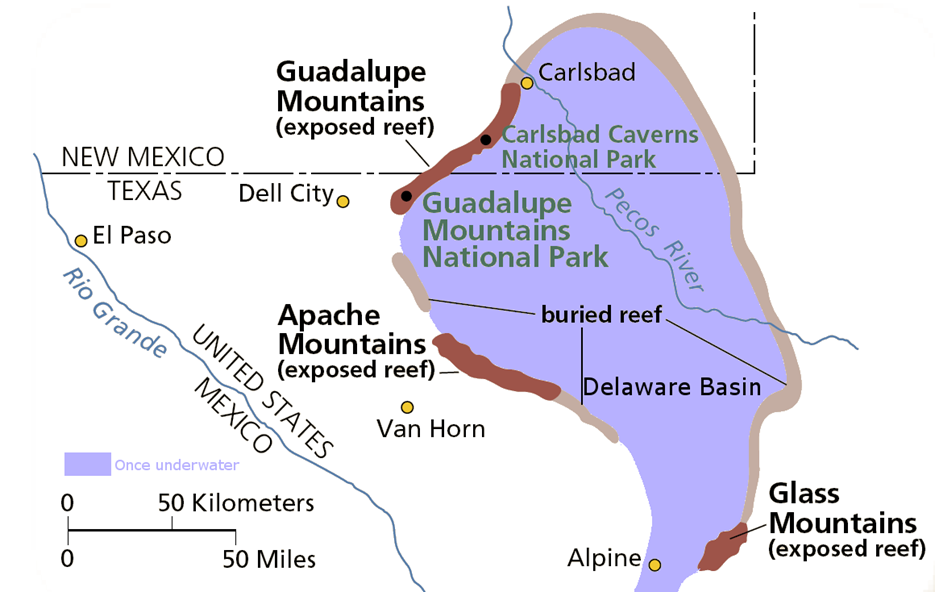
The Castile Formation is found in Texas and New Mexico in the Delaware Basin just to the east of Guadalupe Mountains National Park. The Castile is about 500 m (1600 feet) thick, and consists largely of alternating laminae (thin beds) of anhydrite and calcite. Each anhydrite-calcite pair is called a couplet. There are about 200,000 couplets, each being 1-2 mm thick. The Castile is Permian in age. If you are a YEC, think of it as the Permian part of the flood.
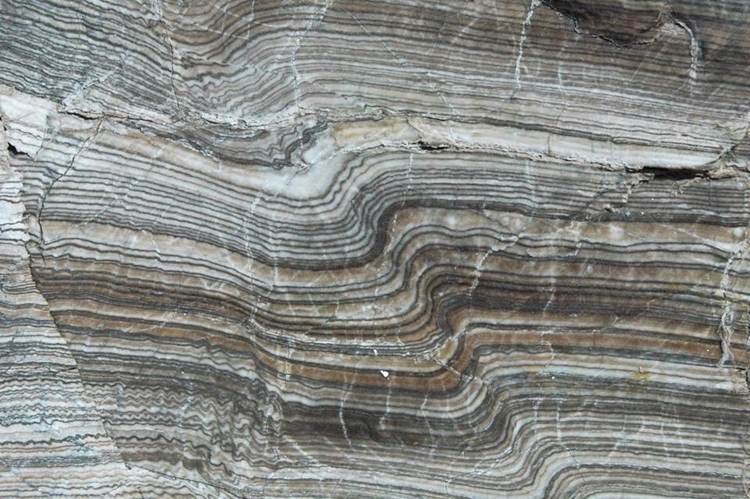
What mechanism could account for this consistent alternation between calcite and anhydrite? The standard geological explanation is that each couplet represents one year of mineral precipitation from concentrated seawater in a restricted basin, a basin which allows only limited input of new seawater. The light-colored anhydrite layers would have formed in the hot, dry season during maximum evaporation, and the darker layers of calcite, which contain organic matter, formed in a cooler, wetter season that allowed for algal blooms. I’m not interested so much right now if that seasonal interpretation is correct, but in pointing out that from an old-Earth perspective there is plenty of time for deposition of 200,000 calcite-anhydrite couplets. Old-Earth geology does not have a Too Many Events, Too Little Time problem.
YECs have proposed various ways for deposition of evaporites, including those in the Castile Formation. These mechanisms include very rapid precipitation from salt-saturated seawater, very rapid precipitation from hydrothermal solutions, and very rapid crystallization from very rapidly emplaced salt magmas.
It really doesn’t matter which of these options a YEC prefers, the challenge is to explain how 200,000 couplets—that is 400,000 individual laminae!—could realistically be produced in the YEC timeframe. It is important to note that the Castile couplets are clean, meaning that there was very little influx of sand, silt, or clay, from the outside while the layers were being formed. They are also laterally extensive, with individual laminae being continuous for distances up to 110 km (70 mi). Deposition of these 400,000 pure laminae would require, during the Permian part of the YEC flood, a complete cessation of normal flood deposition in that area. The giant, cataclysmic, sediment-laden tsunami waves would have continued to inundate other parts of North America, but somehow not disturbed Permian Basin in the slightest. It would also require some mechanism for very rapid deposition of a thin layer of calcite, followed by a thin layer of anhydrite, then a thin layer of calcite, then a thin layer of anhydrite, etc., to make 200,000+ couplets.
How much time would be allowed for in the YEC timeline for the creation of these 400,000 laminae? The Castile formed, in YEC models, during a portion of the Permian part of Noah’s flood. Lot’s of things happened beforehand (Cambrian through early Permian strata) and lots of things happened afterward (Late Permian through the end of the flood). By the standard geologic time scale, the Permian Period represents about 10% of geologic time, and there are several Permian formations in the Delaware basin that need to be accounted for. If we look at the overall local stratigraphy, the Castile represents 500 m out of 5,000 meters of sediments. Again, this is about 10% of the geological activity in the Delaware Basin (western part of the Permian Basin). Ten percent of one year would mean 36 days available in the YEC flood geology scenario for making the Castile. This number is probably high, but let’s go with it. That is 36 days for formation of 400,000 laminae, which comes to about 8 seconds per lamina. That is one thin layer every 8 seconds for 36 days in the middle of the YEC catastrophe, while catastrophic plate tectonics shook the ground and tsunami-like waves crossed continents.
Let’s look a little closer at the YEC options I mentioned earlier.
- Was the Castile Formation formed by precipitation of seawater during the flood? YECs, after all, would have plenty of heat from all the volcanism and catastrophic plate tectonics to evaporate lots of seawater. This would require continuous input of lots of seawater into the basin, and given that most of that seawater would be choked with sand, silt, and clay, I think we can rule that out. Plus, there is the need to explain those 400,000 laminae forming one at a time over a period of a month.
- Was the Castile Formation formed by precipitation of salt from hydrothermal waters injected into seawater or the seafloor by the fountains of the great deep? This would require some mechanism for isolating the Castile from all the catastrophic deposition of sediments occurring in other places. Would this be a one-time injection of fluids? Would it be 200,000 injections of fluids? 400,000 injections? However it happened, it would have required no turbulence as these hydrothermal fluids were entering the basin, as turbulence wouldn’t allow for deposition of laminae that, in some cases, are continuous for distances over 110 km (70 mi). How would such a setup create 400,000 laminae in 36 or so days?
- Was the Castile Formation formed from intrusion of a calcium-carbonate-sulfate magma? The idea proposed by some YECs is that this magma intruded into recently deposited sediments and then began dropping laminae such as what is observed in layered igneous intrusions. This model suffers from some of the same problems as the hydrothermal model, including the fact that rapid intrusion would be turbulent, disrupting tranquil deposition of laminae. One cannot have catastrophic injection of this hypothetical salt magma and tranquil, rhythmic precipitation of alternating bands going on at the same time. Even if it could be demonstrated that such a thing as a salt magma exists (or has existed) and that these could form layered igneous intrusions, the challenge would remain: 400,000 laminae in 36 days.
It really doesn’t matter which YEC model for formation of the Castile formation one uses. A primary problem for each is Too Many Events, Too Little Time. YECs can criticize old-Earth models all they want. Maybe the couplets are not annual varves. So what? Old-Earth models allow for plenty of time for 400,000 laminae to form by whatever mechanism they formed, and YEC models do not.
There’s another item I won’t elaborate on, and that is the heat problem with crystallizing 10,000 km3 of a calcium-carbonate-sulfate melt in a very short period of time, which somehow needs to be coordinated with crystallization of 200,000 calcite-anhydrite couplets.
More Examples
Everywhere one looks at geology in God’s creation, YEC geology runs into the problem of Too Many Events, Too Little Time. Here are a few more examples:
- Yellowstone National Park – The Pleistocene (ice age) geologic history of the Yellowstone Plateau and vicinity includes three large caldera eruptions, the largest of which produced a volume of 2500 km3 of volcanic material. There were at least 100 smaller eruptions of rhyolite and basalt before, between, and after these cataclysmic events. There is abundant evidence for erosion and sediment deposition between eruptions. An ice cap formed that covered the plateau, not once, but at least twice, with rhyolite lava flows in between. Yellowstone volcanism was preceded by a whole string of similar volcanic fields along a track from the Nevada-Oregon boundary northeastward to Yellowstone, making for a total of at least ten large caldera eruptions and hundreds of smaller lava flows. No matter if one puts a lot of this into the flood year or says that all of it occurred after the flood, the problem is Too Many Events, Too Little Time.
- Flood Basalts – The term “flood basalt” does not refer to Noah’s flood, but to the copious amounts of basalt that flooded entire landscapes. Some volcanic provinces, such as the Siberian Traps and Columbia River Basalts, are composed of hundreds of individual lava flows adding up to volumes in the hundreds of thousands to over one million cubic kilometers. These flows did not come out one after another to make a pile of molten rock over a mile thick, but came out one at a time, crystallizing and cooling before the next eruption. It is difficult to imagine how all this can be compressed into a few weeks during the flood.
- Plutonic rocks — Igneous rock bodies that cool underground would take a long time to crystallize and cool. Some batholiths have volumes of over one million km3, are made up of numerous individual plutons, and would have had to have crystallized and cooled in a matter of days or perhaps weeks in YEC flood geology models.
- Metamorphic rocks (such as gneiss, schist, slate, marble) – Many metamorphic processes involve the migration of ions through the crystal lattice of minerals in the solid state, a process that inherently takes time. YEC geology does not allow time for such slowness.
- Dinosaur tracks – Dinosaur tracks occur in many places, and often at multiple levels in the strata at those locations. In each of these cases, YEC models require catastrophic deposition, a pause in deposition, partial dewatering of the sediments, arrival of dinosaurs from somewhere who wander around on the newly exposed flats, then another catastrophic surge that covers the tracks and washes the dinosaurs away. Repeat this process for however many levels the tracks are found in.
- More – I could go on to discuss dinosaur nests, growth of reefs, deposition and dewatering of mudrocks; formation of mineral deposits, the complexity of glacial deposits and landforms; development of buried soils (paleosols), and the complex history of mountain building and erosion. In each of these cases, the persistent problem is Too Many Events, Too Little Time.
What This Isn’t About
I want to highlight two things my Too Many Events critique is not about. First, as I already mentioned, it is not about biblical authority. The Bible does not teach that the 200,000 anhydrite-calcite couplets in the Castile Formation were formed during Noah’s flood. I understand the inferences that led to development of flood geology, but these inferences and conclusions do not have the same authority as the Bible itself. The reality is that the Bible is silent on the timing and method of the origin of the rock record, so no one should dogmatically insist that faithful Christians must accept YEC flood geology.
Second, what I have written is not a matter of me seeing things through a uniformitarian lens rather than YEC catastrophic lens. My complaint is that YEC geology does not work within the YEC framework itself, and a key part of my objection is that Too Many Events, Too Little Time is a serious problem that pervades just about every area of YEC geology. No amount of “If you would just look at the Castile Formation from a YEC catastrophism perspective, you would see that it is easy to see how 400,000 laminae could form in a month” will solve the problem.
Moving Forward
So how should a person with a high view of the inspiration and trustworthiness of Genesis respond to this Too Many Events, Too Little Time conundrum? Unfortunately, some YECs will respond by accusing me of not really believing the Bible, of not really understanding geology, of not really understanding YEC models, of caving into naturalistic thinking, and so forth. None of that is correct, and none of it addresses the challenge.
My first piece of advice is to not take this Too Many Events, Too Little Time objection as a threat to your Christian faith. The truthfulness of the Bible and of Christianity do not depend on whether YEC geology as it now stands is the One True Explanation for why Earth’s rocks and landscapes are the product of Noah’s flood. The better YEC scientists recognize that YEC geological interpretations are just that—fallible interpretations of the Earth—not Scripture itself. The Bible is infallible; our interpretations of both the Bible and geology are fallible. If YEC geology crumbles to the dust, the Bible would emerge unscathed.
Second, rather than dismissing these Too Many Events objections, YECs need to take them seriously. These problems are not imaginary, but a genuine challenge for YEC geology. Old-Earth geologists do not have a problem fitting 100+ eruptions at Yellowstone, dinosaur tracks at multiple levels, or 200,000 calcite-anhydrite couplets into our timeline, but YECs do have this problem. This is not a matter of naturalism vs theism, uniformitarianism vs catastrophism, or believing the Bible vs not believing the Bible. Instead, this is a matter of our observations of God’s creation vs an invention of man, because that is what YEC geology is—a human invention. The people who promote YEC geology might be godly, intelligent, and well meaning, but they are wrong if they think they don’t have a Too Many Events problem. Putting on YEC eyeglasses won’t make the Too Many Events, Too Little Time problem go away.
Finally, I ask my YEC brothers and sisters in Christ to consider that the entire YEC geologic framework might be wrong. Could it be that you are misreading the Bible? Could it be that you are mistaken in the way you integrate scientific observations (e.g., 400,000 laminae in the Castile) with biblical interpretation? YEC geologic models fail to explain why the Earth is the way it is; the Castile is just one of many examples of this. You need to at least consider the possibility that you are misreading or over-reading Scripture.
For My Non-Christian Readers
I’m glad you are here, and ask you to consider that even if you have the “right” understanding of Earth history, you might be missing something far more important. Jesus taught,
“When you see a cloud rising in the west, you say at once, ‘A shower is coming.’ And so it happens. And when you see the south wind blowing, you say, ‘There will be scorching heat,’ and it happens. You hypocrites! You know how to interpret the appearance of earth and sky, but why do you not know how to interpret the present time?” (Luke 12:54-56)
Consider that you might have a spiritual Too Many Events, Too Little Time problem. Life seems long, but really it is short. What good is it if you understand how the Castile Formation formed but have only a little time left on Earth to consider the most important thing, which is your broken relationship with God. These two links point to the solution to our problem of Too Little Time.
God’s Global Plan of Salvation
My testimony of how I came to faith in Christ
Notes:
Various YEC ideas about which rocks are pre-flood, flood, and post-flood are outlined in “ Flood Geology and the Stratigraphic Record” by old-Earth Christian geologist Stephen Mitchell at https://jesusinhistoryandscience.com/?p=1221
Here are a few articles about the YEC salt magma hypothesis:
- Heerema, 2009, A magmatic model for the origin of large salt formations, Journal of Creation, vol. 23, pp. 116-118. – Making a YEC case that evaporite rocks were formed by crystallization from salt magmas.
- Nelstead, 2013, A young-Earth creationist magmatic model for the origin of evaporites. My response to Heerema, 2009.
- Heerema, 2013, Clarifying the magmatic model for the origin of salt deposits. – An article that claims to have “clearly and simply refuted” my response, yet it failed to address, and perhaps understand, many of my critiques.
- Heerema, van Heugten, and Clarey, 2023, The Layered Castile Probably Originated from Salt Magma. Proceedings of the International Conference on Creationism, vol. 9. – This is a poster with an abstract, proposing that the Castile was formed by intrusion and crystallization of a salt magma. This magma pushed aside surrounding sediments as it intruded, producing the ring-like reefs of the Capitan Limestone that surround it. Heat from this intrusion assisted maturation of petroleum.
Glenn Morton was a hero of mine in my waning days of being a YEC in the mid-1980s, and he recognized the Too Many Events, Too Little Time problem for the Castile Formation. He was just about the only person at that time publishing articles in YEC journals highlighting some of the serious problems with YEC geology. This is from his “Geologic Challenges to a Young Earth” in the Proceedings of the International Conference on Creationism, vol. 1 (1986), page 138.
“Several depositional and erosional features found in the geologic record imply a minimum age for the earth. The first of these is the varved or banded deposits found throughout the geologic record. The Salido, Castile, and Bell Canyon formations in west Texas contain 520,000 bands (believed to be 260,000 varves) over total thickness of 1,467 feet.(13) The bands are so uniform in thickness over their entire area of deposition, cores taken in two widely separated oil wells (up to 15 miles apart) show identical patterns of banding. Geologists generally hold that these bands represent yearly varves implying a 260 thousand year time of deposition. If we creationists attempt to explain the deposition of this series of bands by a one year period of deposition, we are requiring one band to be deposited per minute – an impossible task over such wide area. Assuming that these bands are tidally related we can account for the formation of four bands per day (two low tides and two high tides per day yielding two couplets) which would require over 350 years for this deposit to be laid down. It is difficult to see how It could have been deposited within a one year time frame.”
A PDF of this article is available here.
 GeoChristian
The flood basalt situation is even trickier than outlined here. Many flood basalts are interbedded with more silicic volcanism, which is chemically related to the flood basalts below them, but distinct from those above them. So you have a pulse of high-volume mafic magma erupting (like Hawaiian volcanoes but way more active, for any non-igneous folks reading this comment) which starting to slow down as the composition of the magma chamber changes and transitions to more silicic volcanism (like Mt. St Helens), until a new pulse of “fresh” magma rises up, refreshes the chamber, and starts the high volume lava flows all over again.
A very tricky event to fit into a YEC timeline, which gets even worse when you realize how many separate events need to be fit in pre-Flood, during the Flood, and post-Flood!
LikeLike